Welcome to our God category, where we explore spiritual beliefs, religious teachings, and theological concepts from around the world. Here, you’ll find thought-provoking articles on various aspects of faith, spirituality, and the divine. Our content ranges from discussions on different religious traditions to personal reflections on the role of God in our lives.
Our God category is a space for respectful dialogue and open-minded exploration, providing a platform for questions and insights about faith and spirituality. Dive in and discover the many ways people experience and understand the divine.
The question of whether God exists is one of the oldest and most debated topics in human history. Over the centuries, philosophers, theologians, and thinkers have proposed countless arguments to support the existence of a divine being. While some find these arguments compelling, others believe they fall short. Today we will get into some of the most famous arguments for God’s existence and discuss why they may not be as convincing as they seem.
The Cosmological Argument
One of the oldest and most widely discussed arguments for the existence of God is the cosmological argument. It posits that everything that exists has a cause, and because the universe exists, it, too, must have a cause. This cause, the argument goes, must be something outside the universe and not bound by the same laws — namely, God.
Why It Fails
Critics of the cosmological argument often point out that it leads to an infinite regress. If everything must have a cause, what caused God? To counter this, proponents claim that God is a necessary being who doesn’t require a cause. However, this exception seems arbitrary and raises the question of why the universe itself couldn’t be a necessary being without a cause. Additionally, modern physics suggests that the universe could have arisen from quantum fluctuations, challenging the idea that it needs a cause at all.
The Ontological Argument
The ontological argument, first proposed by St. Anselm in the 11th century, is more abstract. It starts with the concept of God as the greatest being imaginable. The argument claims that a being that exists both in the mind and in reality is greater than one that exists only in the mind. Therefore, if God is the greatest being imaginable, God must exist in reality.
Why It Fails
The ontological argument has been criticized for being a mere play on words. Just because we can conceive of the greatest possible being doesn’t mean that such a being exists in reality. Philosophers like Immanuel Kant argued that existence is not a predicate or a quality that can make something greater. Additionally, the argument can be used to “prove” the existence of any perfect entity, which leads to absurd conclusions.
The Argument from Design
Also known as the teleological argument, the argument from design observes the complexity and order in the universe and concludes that it must have been designed by an intelligent being. The complex structure of biological systems, the precise laws of physics, and the fine-tuning of the universe are often cited as evidence of this divine designer.
Why It Fails
One major criticism of the argument from design is the presence of flaws and imperfections in the natural world. If an intelligent designer created the universe, why are there so many imperfections and instances of poor design? Additionally, the theory of evolution by natural selection provides a robust explanation for the complexity of life without invoking a designer. The fine-tuning argument also faces challenges from the multiverse theory, which posits that our universe is just one of many, each with different physical constants. In this context, it’s not surprising that at least one universe would have the conditions suitable for life.
The Moral Argument
The moral argument suggests that objective moral values and duties exist and that these can only be grounded in a divine being. According to this argument, if God does not exist, objective morals do not exist either. Since we observe moral values and duties, God must exist to provide their foundation.
Why It Fails
One issue with the moral argument is the challenge of proving the existence of objective moral values. Moral relativists argue that morals are subjective and culturally dependent. Furthermore, it’s possible to ground morality in secular frameworks, such as human well-being or social contracts, without invoking a divine lawgiver. The existence of moral disagreements and the evolution of moral norms over time also suggest that morality might be more complex and human-centric than the argument allows.
The Takeaway
While the arguments for God’s existence have been influential and thought-provoking, they all face significant challenges and criticisms. The cosmological argument struggles with the question of what caused God, while the argument from design is undermined by natural explanations like evolution and the multiverse theory. The ontological argument is often seen as a linguistic trick, and the moral argument fails to conclusively establish objective moral values or their divine origin.
In the end, whether one finds these arguments compelling often depends on personal beliefs and perspectives. That being said, none of the arguments explain why there has to be only one god and why that god has to be the Abrahamic one.
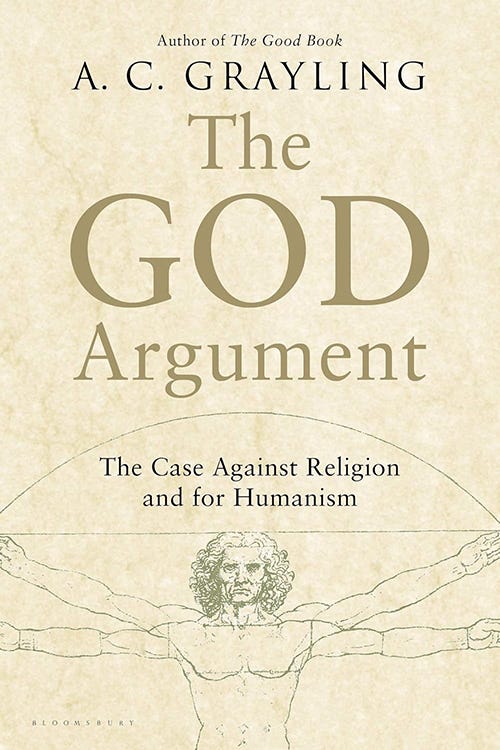
The God Argument by A. C. Grayling is a significant contribution to the debate on religion and secularism. Grayling, a critic of religion, meticulously examines the arguments for the existence of God and the motivations behind religious belief. He then advocates for humanism as a compelling alternative to religion, promoting a worldview grounded in reason, evidence, and a commitment to goodness without infringing on individual beliefs or freedoms.
Grayling presents humanism as an ethical framework based on sympathy and tolerance, aiming to understand human nature and condition. While acknowledging the historical reasons for the emergence of various faiths, he argues that organized religion should no longer hold a privileged status in society. The book asserts that a secular belief system, free from religious dogma, fosters a more compassionate and caring perspective on life.
In No Argument for God, John Wilkinson challenges the prevailing notion that religion is irrational and outdated. While the New Atheists argue that belief in God is a sign of intellectual weakness, Wilkinson asserts that the perceived irrationality of faith is actually a strength. He argues that rationalism imposes artificial constraints on our understanding, focusing only on what can be empirically observed rather than exploring deeper meanings and the “why” behind existence.
Wilkinson contends that while rational investigation is valuable, it often falls short of addressing our deeper yearnings and the search for revelation. He suggests that true understanding and fulfillment come from engaging with the divine in a way that transcends purely logical arguments, leading to a transformative encounter with God that satisfies both the mind and the soul.
Throughout human history, the question of God’s existence has captivated minds, sparked debates, and shaped civilizations. This intense search has kept countless individuals, from ancient philosophers to modern scientists, awake at night. Yet, despite centuries of contemplation and argumentation, constructing a methodology to definitively prove the existence of God remains an impossible task.
The Nature of Proof
The concept of proof varies widely depending on the context. In scientific contexts, the proof requires repeatable observations and experiments. Scientific proof also involves falsifiable hypotheses to ensure reliable and consistent knowledge.
In mathematics, proof is derived from logical reasoning and axioms. Mathematical proofs are rigorous and precise, often requiring logical iterations to conclusively demonstrate the validity of statements. Unlike scientific proofs, and luckily for mathematicians, mathematical proofs are not subject to change through new observations; once proven, mathematical theorems remain true.
Legal proof, on the other hand, relies on evidence and testimony to establish facts beyond a reasonable doubt. Legal proof involves presenting evidence, such as physical objects, documents, or witness testimonies, to build a case. The goal is to convince a judge or jury of the truth of a claim. While judiciary systems aim to minimize it, the evaluation of legal proof is subjective.
When it comes to proving the existence of God, none of these methods are entirely applicable or sufficient. Scientific proof is limited to the natural world and relies on empirical evidence, which is not easily applicable to metaphysical concepts. Mathematical proof requires logical structures and axioms that are not readily available for theological arguments. Legal proof depends on tangible evidence and testimony and unlike the other two types, it is not objective and universal.
The Limitations of Science
Science has been remarkably successful in explaining natural phenomena and uncovering the mysteries of the universe. Through detailed observation, experimentation, and the development of theories, science has advanced our understanding of everything from the smallest particles to the vastness of space. However, science has inherent limitations when it comes to proving or disproving the existence of God.
One of the main principles of science is methodological naturalism, which means that science operates under the assumption that natural causes explain natural phenomena. While methodological naturalism is powerful for investigating and understanding the world around us, it cannot, by definition, investigate supernatural claims, one of which is God, an entity that is not bound by the laws of nature.
Another limitation is that science relies on collecting data through observation and experimentation in the physical world. God, as typically conceived, exists beyond our physical world, making it impossible to gather direct, empirical evidence of their existence.
Furthermore, although experiments must be repeatable and their hypotheses falsifiable in science, the concept of God often falls outside these criteria.
Lastly, the scope of scientific inquiry is limited to understanding how the natural world works. However, it does not address why the natural world exists in the first place or whether there is a purpose behind its existence, leaving these types of questions to philosophers or theologians.
Philosophical Challenges
Philosophy has long grappled with the question of God’s existence, offering various arguments and counterarguments over the centuries. However, it, too, faces significant hurdles in providing a definitive answer to this impossible question.
One major challenge is the definition of God, which lacks universality as different cultures and religions conceive of divine beings in various ways. Some see God as an all-powerful, all-knowing, and all-good entity, while others have more abstract or varied interpretations. This diversity makes it difficult to prove the existence of any specific deity because the criteria for proof vary widely.
Philosophers have proposed logical arguments for God’s existence, such as Anselm’s ontological argument, suggesting that the very concept of God as the greatest being implies God’s existence, as existence is a necessary attribute of greatness. However, these ontological arguments often rely on disputable premises and word games.
Another significant hurdle is the problem of evil. Should an all-powerful, all-knowing, and all-good God exists, why does suffering occur? Philosophers have struggled with this question for centuries, offering various justifications for God’s tolerance to evil.
The issue of infinite regress also presents a philosophical challenge. The question “If God created the universe, then what created God?” leads to an infinite regress, where each cause must have a prior cause, stretching back infinitely.
The Limits of Human Understanding
The limits of our ability to comprehend the nature of existence and reality become evident when tackling profound questions like the existence of God.
One major limitation comes from cognitive biases. Human thinking is subject to various biases that can influence our perception and reasoning. These biases can lead us to see patterns where none exist, make illogical leaps, or favor information that supports our preconceptions while ignoring evidence to the contrary.
Another limitation is the scope of our perception. Our senses and the instruments we have developed to extend them can only detect a tiny fraction of reality. For example, we cannot see ultraviolet light without special equipment, and we are only beginning to understand phenomena like dark matter and dark energy.
Moreover, the concept of an all-powerful, all-knowing being may be inherently beyond human comprehension. Our brains have evolved to handle the complexities of daily life on Earth, not to grasp infinite or absolute entities.
Faith and Personal Experience
For many people, belief in God is based on faith and personal experience rather than empirical evidence.
One key reason is the subjective nature of personal spiritual experiences. These experiences can be deeply meaningful and transformative for individuals, providing a sense of connection, purpose, or understanding. However, they are inherently subjective and not verifiable by others. What one person experiences as a divine encounter, another may interpret differently or not at all. This subjectivity makes it difficult to use personal experiences as a basis for universal proof of God’s existence.
Another important factor is faith. Religious faith often involves believing without concrete proof. For many, faith is about trust and conviction in the absence of empirical evidence. This means that the quest for definitive, empirical evidence of God can seem somewhat contradictory to the nature of faith itself. Faith is not necessarily about seeking scientific validation but about a personal commitment to a belief system or deity.
The diversity of beliefs around the world further highlights that personal conviction, rather than universal proof, drives belief in God. Different cultures and religions have developed a wide variety of spiritual beliefs and practices, each with their own conceptions of the divine. This diversity suggests that belief in God is often rooted in cultural, historical, and personal contexts, rather than a single, universally accepted proof. The existence of many different religions and spiritual paths indicates that what is compelling or convincing for one group may not be for another, underscoring the role of personal and collective experiences in shaping belief.
The Problem of Unfalsifiability
A key issue in proving God’s existence is the concept of unfalsifiability.
One aspect of this issue is the shifting goalposts. As science explains more natural phenomena, the domain of God often shifts to areas that are not yet explained. This means that as our scientific understanding grows, the idea of God is continually repositioned to remain outside the reach of scientific scrutiny. This perpetual shifting makes the concept of God unfalsifiable, as it continually retreats to the margins of our current knowledge.
Supernatural claims are another factor that contributes to unfalsifiability. By definition, supernatural explanations fall outside the realm of natural investigation. Science is designed to study and explain natural phenomena, so anything deemed supernatural is beyond its scope. Because of this, supernatural claims, including those about God, cannot be conclusively proven or disproven by scientific methods. This inherent limitation ensures that supernatural explanations remain unfalsifiable.
The absence of evidence is also a significant point. While it is true that the absence of evidence is not evidence of absence, the lack of conclusive proof for God’s existence after millennia of searching is noteworthy. Despite extensive philosophical, theological, and scientific inquiry, no definitive evidence has emerged to conclusively prove God’s existence. This persistent absence of evidence highlights the challenge of unfalsifiability, as it suggests that the question of God’s existence may be inherently beyond the reach of empirical investigation.
Logical and Epistemological Considerations
From a logical and epistemological standpoint, proving God’s existence faces several challenges.
One significant challenge is the burden of proof. In logical argumentation, the burden of proof typically lies with the person making a positive claim. If someone asserts that God exists, it is their responsibility to provide evidence to support this claim. On the other hand, proving non-existence is often impossible, as it would require demonstrating that something does not exist anywhere under any circumstances. This asymmetry makes it particularly challenging to address the existence of God through traditional logical methods.
Another influential idea is Russell’s teapot, introduced by philosopher Bertrand Russell. He argued that the burden of proof lies with the person making unfalsifiable claims. Russell used the analogy of a teapot orbiting the sun: while it is impossible to disprove the existence of such a teapot, the lack of evidence for it means that we are not justified in believing in its existence. Similarly, if someone claims that God exists but provides no verifiable evidence, the burden of proof remains on them, as unfalsifiable claims do not warrant acceptance without substantial evidence.
Occam’s Razor also presents a challenge. This principle suggests that simpler explanations are preferable to more complex ones when multiple explanations are available. In the context of the existence of God, Occam’s Razor might favor natural explanations over supernatural ones. For instance, if natural phenomena can be explained through scientific theories without invoking a divine being, the principle of Occam’s Razor would suggest that we should prefer these simpler, natural explanations. This principle encourages skepticism towards more complex, supernatural claims when simpler alternatives suffice.
The Impact of Cultural and Historical Context
Our understanding of God and the quest to prove divine existence are deeply influenced by cultural and historical factors.
One major factor is cultural diversity. Throughout history, different cultures have developed vastly different concepts of divinity. From polytheistic pantheons in ancient Greece and Rome to the monotheistic God of Abrahamic religions, the variety of divine conceptions is immense. This diversity makes it challenging to prove the existence of any one particular god, as each culture’s understanding of divinity is shaped by its unique history, values, and experiences. The multiplicity of beliefs suggests that the concept of God is more fluid and culturally relative than a single, universally accepted entity.
Historical development also plays a significant role in shaping religious ideas. Over time, religious beliefs and practices have evolved, reflecting the changing social, political, and intellectual contexts of different eras. For example, the transition from polytheism to monotheism in many cultures was influenced by broader shifts in societal organization and philosophical thought. These changes indicate that religious ideas are not static truths but are instead dynamic and responsive to the conditions of their time. This historical evolution makes it difficult to argue for the timeless and unchanging existence of a specific deity.
Psychological and sociological factors also contribute to the belief in God. Humans have a natural tendency to seek patterns, meaning, and explanations for the unknown. This inclination can lead to the creation and acceptance of religious beliefs, as they provide a framework for understanding the world and our place in it. Additionally, social structures and communities often reinforce these beliefs, creating a sense of belonging and shared purpose. These psychological and sociological influences suggest that belief in God may arise more from human nature and societal dynamics than from empirical provability.
The Takeaway
The impossibility of proving God’s existence stems from a combination of factors: the limitations of scientific inquiry, the philosophical challenges involved, the bounds of human understanding, the nature of faith and personal experience, the problem of unfalsifiability, logical and epistemological considerations, and the influence of cultural and historical contexts.
Ultimately, the question of God’s existence is about belief rather than proof.
For centuries, the question of whether a higher power exists has sparked impassioned God debates and divisions among humanity. Believers cling to their faith as a source of meaning, comfort, and spiritual enlightenment. Atheists, grounded in skepticism and rationality, demand empirical proof and dismiss the supernatural. When these fundamentally disparate worldviews collide head-on, the discourse often devolves into a combative arena where the principal aim is not mutual understanding but aggressive debate with the goal of emerging victorious.
This adversarial framing, however, is misguided and unproductive. Treating dialogues about religious beliefs as battles to be won is an exercise in futility that rarely results in changed minds or newfound common ground. Rather, it entrenches existing biases and erects higher barriers to meaningful connection across different perspectives. The way forward lies not in fruitless debate but in reimagining these interactions as opportunities for empathetic listening, expanded awareness, and the discovery of our shared hopes and values as human beings.
The Pitfalls of Fruitless Debate
At the core of the limitations of the God debates lies the inherent personal nature of faith. Shaped by a complex tapestry of life experiences, cultural backgrounds, and deeply held convictions, faith transcends simple arguments. For the devout, belief in a higher power serves as an anchor in the storm of existence, offering solace, purpose, and a framework for comprehending the universe’s mysteries.
On the other side of the God debate spectrum, atheism prioritizes reason and evidence. Skepticism toward the supernatural reigns supreme, with empirical data, rational inquiry, and logic seen as the keys to unlocking truth. When these paradigms rooted in faith clash with those demanding proof and materiality, the God debate becomes a battleground. Each side speaks a different philosophical language, their axioms as distant as stars.
The result? Entrenched positions and adversarial dynamics. Believers and non-believers cling to their corners, attempting to dismantle the other’s worldview through rhetoric, logic, and dismissal of core tenets. This quest to “win” the God debate through argumentative force sacrifices true understanding and dehumanizes the opposition.
The ego’s yearning for victory further cripples the God debate. When convictions become battlegrounds for intellectual dominance rather than spaces for exploring differences, the purpose is lost. Minds remain stubbornly closed, and people leave more entrenched than before. This is a tragedy, considering the enriching potential of engaging with diverse systems of meaning and interpretation.
The truth is, for most, beliefs surrounding God are not products of mere rational convincing. They emerge from the very core of our being, reflecting how we ascribe meaning to life itself. To treat these profound perspectives as ideas to be adopted or discarded through forceful arguments in the God debate fundamentally disregards the human experience that birthed them.
A Wiser Path Forward
Yet, avoiding discussing these existential questions within the realm of God debates would be an immense loss for both collective understanding and individual growth. Exploring our divergent beliefs about whether a higher power exists has immense potential as a catalyst for bridging ideological divides and illuminating the full depth of the human condition across cultures and creeds.
However, to actualize this possibility, a fundamental reframing of God debates is required. Rather than approaching faith-based discourse as a detached thought experiment or a God debate to be won at all costs, we must treat it as an intensely personal window into how others derive meaning and grapple with life’s profundities. In doing so, the importance shifts from dogmatic conflict within God debates towards cultivating greater empathy, intellectual flexibility, and mutual respect.
There is immense value in truly listening to perspectives different than our own within God debates, with an openness to have our horizons expanded. By seeking to understand the emotional anchors, life experiences, and reasoning that shapes each person’s relationship to faith and existential questions, space is created for greater empathy and appreciation of the diverse lenses through which humankind interprets its reality.
After all, religion and questions of faith do not exist in a vacuum – throughout history, they have been intimately intertwined with cultural identity, moral and ethical foundations, community preservation, and spiritual expression. To arrogantly discard the beliefs of others without attempting to understand their origins and psychological significance is to ignore the very essence of the human experience, even within the context of God debates.
An attitude of open curiosity and willingness to enter unfamiliar philosophical ecosystems with humility allows for personal growth and enlightenment that are inaccessible when the mind is closed during God debates. Whether an atheist gaining new appreciation for the inner worlds that religious faith can open or a believer considering novel philosophical frameworks, the benefits of respectful cross-perspective engagement within God debates are manyfold.
Furthermore, the attempt at mutual understanding within God debates often reveals commonalities that transcend religious divides. Beneath seemingly irreconcilable differences about the existence of God lie shared human yearnings – for love, purpose, ethical actualization, inner peace, and sensemaking of the unknown. Progressively mining these commonalities by remaining open to our differences as entry points for connection rather than sources of conflict within God debates strengthens social cohesion and collective empathy.
In our increasingly pluralistic societies, fostering tolerance and mutual understanding across ideological lines is not only enriching but essential. Reimagining religious discourse, including God debates, as a source of interpersonal connection and insight rather than conflict promotes the healing of historical divides and cultivates inclusive communities united by compassion and appreciation of diverse meaning-making.
The relentless human drive to understand our origins and place in the cosmos will never abate. Whether contemplating the divine, dissecting the mysteries of existence through scientific empiricism, or syncretically embracing various sources of enlightenment, these spiritual strivings reflect our great capacity for seeking profundity amidst the vastness.
To cling stubbornly to the pretense that one perspective has achieved absolute truth and thus must invalidate all others within God debates is to neglect the awe-inspiring complexity of both the universe and human consciousness. A wiser approach recognizes that beliefs about the metaphysical represent separate yet equally valid lenses for perceiving the enigma of being itself.
In this light, polarizing God debates give way to complementary portfolios of meaning – with religious faith and philosophical doubt existing not in conflict but in dynamic interplay. Either perspective alone is incomplete, yet their paradoxical convergence reflects the awesome difficulty in unraveling the full essence of existence through any singular ideological focus, even within the realm of God debates.
Ancient Wisdom for a Modern World
For millennia, the god debate has raged, fracturing traditions and igniting ferocious contention. Yet, perhaps the key to a more enlightened discourse has been hiding in plain sight, woven into the very fabric of those same religions and philosophies.
Mystics and transcendent thinkers throughout history have warned us of the human ego’s need for conceptual conquest. This need, they argue, fundamentally distorts our ability to grapple with existential questions. Eastern philosophies, from Buddhism to Taoism, promote holding seemingly contradictory ideas in balance, finding equilibrium instead of eradicating them through dogmatic insistence in the god debate. Surrendering the desperate need to be “right” opens the door to perceiving truth from multiple angles, fostering a nuanced understanding that transcends the confines of the traditional god debate.
Socrates, a founding voice of Western philosophy, emphasized the importance of recognizing our limitations. He believed wisdom lay in “knowing how little we know,” a perspective at odds with the certitude that often taints the god debate. Perhaps, the very essence of enlightenment lies in approaching these ultimate questions with perpetual openness and an acceptance of our ignorance.
Furthermore, many scholars, both religious and non-religious, recognize the psychological dangers of clinging to rigid belief systems as a form of identity. When beliefs become static shields against uncertainty, they morph from tools of exploration into impediments, fueling the divisions that plague the god debate. Instead, when we traverse the vastness of questions regarding faith, higher powers, and existence itself, wisdom lies in embodying the very curiosity and humility these traditions extol.
Rather than clinging to concrete answers for ego-reinforcement or a sense of belonging, the path to deeper truth and growth lies in abandoning rigid dogmatism altogether. In its place, an ethos of perpetual seeking – of asking questions rather than insisting on pre-determined answers – breathes new life into the stale air of the god debate. God debates recede, replaced by dialogues fostering mutual learning and wonder. With rigid attachment abandoned, paradoxes become recognized opportunities for integrating complementary insights. Ultimately, the conversation evolves from a competition of “who is right” to a collective exploration of the sublime mysteries of being itself.
The Way Forward
The human spirit has long grappled with the God debates, those existential inquiries into our universal origins. These profound contemplations, meant to illuminate truth, often devolve into ego-driven clashes. Forceful rhetoric and attempts at conversion turn these dialogues into battlegrounds for intellectual dominance.
This adversarial framing is deeply flawed. Treating religious beliefs and ultimate questions as debates rather than explorations erects walls to understanding. It strengthens existing biases, diminishes appreciation for diverse experiences, and sacrifices connection for pride and dogma.
A wiser approach recognizes that beliefs about the metaphysical are intensely personal, woven from the intricate tapestry of our cultural, emotional, and existential landscapes. To arrogantly dismiss another’s perspective without understanding its significance is to ignore the very essence of the human experience we seek to illuminate.
By reframing religious discourse through open curiosity, a willingness to expand our horizons, and the courage to hold the tension of paradox, we open a portal to realms of growth, enlightenment, and collective understanding that rigid certainty obstructs. Humility and perpetual seeking breathe new life into stale polemics, transforming them into dynamic dialogues fueled by mutual learning and wonder.
Within this cross-perspective connection emerge profound commonalities that transcend ideological divides. Shared human values, ethical foundations, and existential yearnings unite us more than any God debate could fracture. When we cultivate an empathetic understanding of how others find meaning and guidance in the vastness of existence, we witness parallels far more binding than any God debate could break.
In our increasingly pluralistic world, fostering respectful cross-pollination of beliefs is not just enriching, it’s essential. It upholds the diversity and social cohesion that catalyzes human flourishing. Cultivating the wisdom to hold seemingly incompatible truths in balanced exploration heals historical divides and strengthens the ethics of coexistence. It illuminates our shared awesome responsibility to seek maximal understanding and steward this miracle of existence we all inhabit.
The path forward transcends fruitless conflict. It embraces courage, openness, and profound humility when confronting life’s great mysteries. We must recognize the full spectrum of religious, philosophical, and scientific investigations as invaluable vantage points, offering incomplete yet complementary insights into the enigma of being itself.
In this light, polarizing God debates fade away, and rigid dogmas dissolve into dynamic portfolios of meaning-making. It becomes an eternal conversation where all thoughtful perspectives are reverently engaged as facets of an inconceivable cosmic whole. The ultimate answer may forever elude us, yet the humble search itself sparks transcendence, igniting our shared capacities for wisdom, awe, and illuminating our collective identities as heroic meaning-seekers united by our very quest.
Across cultures, faiths, and worldviews, ancient teachings have long imparted the paradoxical truth: wisdom flourishes not from fortresses of certainty, but from surrendering the ego and its attachment to being right. In the space of “not knowing,” unbounded curiosity and universal wonder blossom.
When traversing the eternal human questions surrounding existence, faith, and cosmic origins, perhaps we should embody this sacred openness. Let us temper our drive for rigid resolution with a perpetual deference to life’s awesome complexities. In doing so, the discourse evolves from wanting to spiritually elevating – a journey of souls exploring reality’s unfathomable kaleidoscope together, with more empathy and awe than certainty could ever aspire to.
“https://www.nd.edu/faith-and-service/” by Alvin Plantinga discusses the concept of religious belief as properly basic, meaning not requiring external justification.
Throughout history, the role of religion has been pivotal in helping individuals find meaning, solace, and resilience amidst life’s formidable challenges. Whether coping with the loss of a loved one or contemplating the vast mysteries of the cosmos, belief in a transcendent power, cosmic force, or divine entity provides insights into profound metaphysical enigmas. These mysteries—our origins, purpose, and the potential of an afterlife—have intrigued humankind across diverse cultures and eras. The deep-seated conviction in a wise, benevolent deity orchestrating a universal master plan offers a profound sense of safety, balance, and inner tranquility. For many, the role of religion is an unwavering pillar of fortitude, guiding them through distress, bereavement, and solitude. Beyond personal solace, religious and spiritual doctrines shape moral philosophies, ethical behaviors, and collective rituals that have left an indelible mark on civilizations.
We invite you to explore the complex ways in which faith and spirituality affect our lives, both on a personal and communal level.
Need for God – The Role of Religion
For those grappling with life’s hardships and emotional upheaval, solace and purpose can often be found in believing in a higher power, serving them as a crucial pillar of inner strength, resilience, and tranquility. Fundamentally, faith in a supreme, transcendent entity or entities beyond our tangible world provides answers to profound metaphysical questions that have intrigued humanity for ages, such as “Why are we here?”, “What is our purpose?” and “What happens after we die?”. Seeking these answers solely through logic can cause significant anxiety, uncertainty, and existential fear. Yet, the deep assurance and belief that our lives are part of an elaborate cosmic plan orchestrated by an omniscient, benevolent deity can bring solace, dispel doubts, and foster a state of calm composure.
Moreover, the conviction that an omniscient, all-loving, everlasting divine presence perpetually guides and observes us at every turn, even amidst adversity and calamity, can endow believers with a steadfast source of comfort, emotional fortitude, and resilience through the most trying times.
Be it the anguish of profound loss, the physical and emotional distress of a terminal condition, or the intense solitude and seclusion that may ensue, the belief in a compassionate higher power’s constant companionship can render the harshest of ordeals less intimidating and imbue them with more profound significance. This spiritual connection instills the assurance that we are never truly isolated, even at our lowest points, and that a blissful afterlife in a superior realm is forthcoming, where reunions with our lost loved ones and ultimate solace are promised. For numerous individuals, this conviction is an invaluable emotional anchor and a wellspring of fortitude that enables them to withstand life’s sternest challenges and press ahead.
At its most profound and commendable, a spiritual belief system founded on faith and veneration of the divine not only offers solace in times of emotional distress but also imparts a profound sense of purpose and metaphysical importance to its adherents. These belief systems forge ethos and values, establishing a moral philosophical framework that guides ethical behavior and virtuous conduct in harmony with the tenets of the faith. They unite adherents in communities connected by common traditions, shared objectives, and hallowed practices. Dedication to religious principles promotes discipline, selflessness, and reverence for what is holy according to divine intent. These factors contribute to the significant cultural, ethical, and existential role that religious and spiritual belief systems, with their diverse practices, have played in numerous civilizations across history.
Yet, the moral frameworks, philosophies, origin narratives, and rituals of many major world religions are often hotly debated and seen as problematic, archaic, and at odds with their professed values of universal love, peace, and ethical conduct. Historically, religious teachings and their interpreters have fostered ideological bigotry, stifled free thought and expression, curtailed individual liberties, and even incited violence, prejudice, animosity, and injustice toward those regarded as heretics or outsiders. Scientifically, assertions regarding the origins of Earth, the cosmos, and human nature contradict empirical evidence and established facts of evolutionary biology. Narratives, parables, and moral tales, initially devised as thought experiments to convey ethical teachings, have been misinterpreted and warped into literal historical or scientific facts, demanding acceptance without question or amendment.
In a Nutshell
Ultimately, the personal conviction in a higher metaphysical power and secular spirituality can serve as a remarkable source of emotional support and meaning during times of significant adversity. However, one does not need to fully adhere to speculative mythologies, strict superstitions, unproven claims of absolute truth, or outdated cultural mandates of traditional organized religions to find such sustenance.