Religion often teaches that faith—believing in something without tangible evidence—is a virtue. While this idea is intended to inspire so-called spiritual growth and trust, it has unintended consequences that profoundly impact society.
At the heart of many religious teachings is the notion that faith is a noble quality. Believing in something beyond the visible and the provable is often framed as a sign of one’s spiritual strength and commitment, potentially comforting and providing a sense of belonging to individuals, helping them go through life’s biggest uncertainties. However, this emphasis on faith without evidence also carries risks, particularly when it comes to critical thinking and susceptibility to exploitation.
When faith is celebrated over evidence, it creates an environment where questioning and skepticism are viewed with suspicion or even hostility, discouraging individuals from challenging dubious claims or looking at alternative viewpoints. In a society where uncritical acceptance is encouraged, people also become more vulnerable to manipulation by those who exploit their trust. Whether through charismatic leaders, misleading advertisements, or deceptive political rhetoric, the absence of a demand for evidence makes it easier for false or harmful ideas to gain traction.
In politics, for instance, leaders who make grand promises without concrete plans or evidence likely find it easier to garner support from those who are inclined to believe without scrutiny. Similarly, in business, companies making exaggerated claims about their products or services can take advantage of consumers who trust without verifying. In both cases, the lack of evidence-based thinking leads to personal and societal harm.
Moreover, this inclination towards accepting without proof undermines critical thinking skills. When faith is prioritized over evidence, individuals become less inclined to question or critically analyze the information presented to them, killing intellectual curiosity and promoting a culture where challenging established beliefs or practices is discouraged.
The implications of this dynamic extend beyond individual experiences. A society that values faith over evidence creates an environment where misinformation and exploitation thrive. Without anything robust for evaluating claims and demanding evidence, harmful practices and falsehoods multiply, impacting everything from public health to social justice.
The Takeaway
Individuals who are empowered to think critically and demand evidence are better equipped to go through life and make choices grounded in reason rather than unexamined faith. Not selling belief without proof as a virtue safeguards against exploitation and also promotes a culture of intellectual integrity.
Online, morality is a popular topic among theists and atheists. Theists often claim that if morality’s source is not divine, then there is no clear right and wrong, hence the atheist path is the immoral path. In return, it is not unusual to hear atheists say they are more moral than theists because they have better critical thinking skills. However, dividing people into “theist” and “atheist” categories and coming to conclusions is misleading and unhelpful. It is suspiciously too simple, to say the least.
Income and education levels have a clear impact on the morality not only of individuals but also of their parents who brought them up, which shouldn’t come as a surprise to anyone. Since atheists and theists don’t necessarily share the same average income or education levels, we can’t draw a straight line between religion and immoral behavior, even if an average atheist is more moral than an average theist.
However, what is evident is that religion is far from being a foolproof tool for ensuring ethical conduct, and it’s not the most effective path to morality.
Teaching Children Right and Wrong
Regardless of their belief in God, some parents teach their children to use reason and common sense to judge right and wrong. These parents set their children up for success because their loved ones learn to think critically, adapt to new situations, and resist manipulation.
On the other hand, some parents rely solely on a list of rules from a holy book, making their children vulnerable to corruption. After all, it makes sense that someone who blindly follows prescribed morals without understanding the underlying principles would be more susceptible to manipulation. We see this dynamic play out in regions like the Middle East, where rigid interpretations of religious texts sometimes lead to actions many would consider unethical.
Prescription for a Brighter Future.
First, we should move away from using simplistic labels such as “theist” and “atheist.” These terms do not fully capture the complexity of an individual’s character, reducing them to a single oversimplified label.
Second, we need to acknowledge that multiple factors influence moral behavior and that religion is only one aspect of the equation. Other elements, such as education, economic stability, and social environment, play significant roles in shaping how individuals act and make decisions.
Third, it is only logical to prioritize teaching critical thinking and ethical reasoning from an early age to help children face complex moral dilemmas in the future. These skills are indispensable for making informed and thoughtful decisions throughout their lives.
Lastly, we must resist oversimplifying matters
[amazon table=”3281″]
The Takeaway
The bottom line is moral behavior is a function of many factors, including education, economic circumstances, and how we’re taught to deal with ethical questions.
At the end of the day, the path to a more moral society isn’t through blind faith or rigid categorizations but through critical thinking, education, and a willingness to understand the complexities of human behavior.
At some point in your life, you must have heard the phrase “absence of evidence is not evidence of absence” at least once. It might sound like a tongue twister, but this powerful statement holds a wealth of wisdom, especially in all btanches of science, critical thinking, and everyday life. Today, we’re going to unpack this concept and explore why it’s so important in our quest for knowledge and understanding.
What Does It Mean?
At its core, “absence of evidence is not evidence of absence” means that just because we haven’t found proof of something doesn’t necessarily mean that it doesn’t exist or isn’t true. In other words, a lack of evidence doesn’t automatically disprove an idea or theory.
This concept is crucial in many fields, from scientific research to criminal investigations and even in our day-to-day lives, reminding us to keep an open mind and not jump to conclusions too quickly.
The Scientific Perspective
In science, open-mindedness is particularly important. Scientists are always searching for evidence to support or disprove theories. But here’s the thing: just because they haven’t found evidence for something yet, it doesn’t mean they never will.
Take the search for extraterrestrial life, for example. We haven’t found concrete evidence of aliens yet, but that doesn’t mean they don’t exist. It just means we haven’t discovered them (if they’re out there). Scientists continue to explore and search because they understand that the absence of evidence isn’t the final word.
Another great example is the concept of dark matter. For years, scientists observed that there seemed to be more gravity in the universe than could be explained by the visible matter we can see. To explain this phenomenon, they proposed the existence of dark matter. While we still haven’t directly observed dark matter, the absence of direct evidence doesn’t mean it doesn’t exist. Scientists continue to research and look for ways to detect it.
The Multiverse Theory
Let’s talk a bit about a mind-bending example: the multiverse theory, which suggests that our universe might be just one of many universes existing parallel to each other, and the possibility of more than one universe has captured the imagination of scientists and sci-fi enthusiasts alike.
Currently, we don’t have conclusive evidence that other universes exist. But does that mean we should dismiss the idea entirely? Not at all! The absence of evidence for the multiverse doesn’t prove it doesn’t exist. It simply means we haven’t found a way to detect or observe other universes yet – if they’re out there.
Scientists continue to work on this theory because they understand that our current lack of evidence doesn’t rule out the possibility. Who knows? Future technological advancements or new theoretical frameworks might one day allow us to find evidence for or against the multiverse theory.
The Impossibility of Proving a Negative
Another important aspect of this concept is the difficulty – often impossibility – of proving a negative. This is where the famous example of Russell’s Teapot comes in.
Philosopher Bertrand Russell proposed a thought experiment: imagine he claimed that a teapot was orbiting the Sun somewhere between Earth and Mars, but it was too small to be detected by our telescopes. It would be absurd to expect others to believe this claim simply because they couldn’t prove it wrong.
This example illustrates why the burden of proof usually lies with the person making a claim, not with those skeptical of it. It’s nearly impossible to prove that something doesn’t exist anywhere in the universe. The absence of evidence for Russell’s teapot isn’t proof that it doesn’t exist, but it’s also not a reason to believe that it does.
Practical Applications in Everyday Life
This principle isn’t just for scientists and philosophers – it has practical applications in our daily lives too. Here are a few examples:
Just because your friend hasn’t called you in a while doesn’t necessarily mean they don’t care about you. There could be many reasons for their silence that you’re unaware of.
Not hearing back from a company after an interview doesn’t automatically mean you didn’t get the job. They might still be in the decision-making process.
The absence of symptoms doesn’t always mean you’re not ill. Some conditions can be present without obvious signs, which is why regular check-ups are important.
Just because there’s no evidence linking a suspect to a crime doesn’t necessarily mean they’re innocent. It just means there’s not enough evidence to prove guilt.
The Importance of Keeping an Open Mind
Understanding that the absence of evidence is not evidence of absence encourages us to keep an open mind. It reminds us that our current knowledge is limited and that there’s always more to learn and discover.
However, open-mindedness doesn’t mean we should equal probability to any claim or theory without conclusive evidence that comes our way. Skepticism is healthy and necessary. It is just that we should be willing to consider new ideas and be open to changing our minds if new evidence comes to light.
Know Your Limits
While it’s important to remember that absence of evidence isn’t evidence of absence, we also need to be careful not to take this principle too far. If we’ve looked extensively for something and found no evidence, it’s often reasonable to think it probably doesn’t exist – even if we can’t be 100% certain.
Let’s consider some examples to understand this better:
Unicorns, Space Teapots and Vulcan
There’s no good reason to believe that unicorns or teapots orbiting the sun exist. It wouldn’t make sense to spend time and resources searching for these.
However, scientists though it was worthwhile to look for a a hypothetical planet called Vulcan orbitting between Mercury and the Sun because it potentially explain peculiarities in Mercury’s orbit. Ultinately, Einstein’s theory of general relativity later explained these anomalies without the need for an extra planet.
Alien Life
Our galaxy, the Milky Way, is estimated to have between 200-400 billion stars. Even more mind-boggling, scientists think there could be around 2 trillion galaxies in the part of the universe we can see. With numbers this big, even if the chance of life emerging is small, it’s quite possible that it has happened at least once more in the universe besides Earth, making scientists believe it’s sensible to keep looking for signs of alien life.
Multiverse and Many-Worlds Theories
Some scientific ideas, like the Multiverse Theory and the Many-Worlds Theory, are appealing to scientists even though we don’t have direct evidence for them yet. The Multiverse Theory helps explain why our universe seems to be “just right” for life to exist, which otherwise seems like an incredibly lucky coincidence. The Many-Worlds Theory offers an explanation for why particles behave differently when we observe them compared to when we don’t. These theories solve some puzzling problems in physics, which is why scientists continue to explore them despite the current lack of direct evidence.
The key is to balance open-mindedness with critical thinking and respect for the evidence we do have.
The Takeaway
“Absence of evidence is not evidence of absence” is more than just a catchy phrase. It’s a reminder of the limits of our knowledge and the importance of continued exploration and learning.
Remember, some of the greatest discoveries in history came from people who were willing to look beyond the absence of evidence and ask, “What if?” So go ahead, embrace the uncertainty, and keep exploring.
The question of whether God exists is one of the oldest and most debated topics in human history. Over the centuries, philosophers, theologians, and thinkers have proposed countless arguments to support the existence of a divine being. While some find these arguments compelling, others believe they fall short. Today we will get into some of the most famous arguments for God’s existence and discuss why they may not be as convincing as they seem.
The Cosmological Argument
One of the oldest and most widely discussed arguments for the existence of God is the cosmological argument. It posits that everything that exists has a cause, and because the universe exists, it, too, must have a cause. This cause, the argument goes, must be something outside the universe and not bound by the same laws — namely, God.
Why It Fails
Critics of the cosmological argument often point out that it leads to an infinite regress. If everything must have a cause, what caused God? To counter this, proponents claim that God is a necessary being who doesn’t require a cause. However, this exception seems arbitrary and raises the question of why the universe itself couldn’t be a necessary being without a cause. Additionally, modern physics suggests that the universe could have arisen from quantum fluctuations, challenging the idea that it needs a cause at all.
The Ontological Argument
The ontological argument, first proposed by St. Anselm in the 11th century, is more abstract. It starts with the concept of God as the greatest being imaginable. The argument claims that a being that exists both in the mind and in reality is greater than one that exists only in the mind. Therefore, if God is the greatest being imaginable, God must exist in reality.
Why It Fails
The ontological argument has been criticized for being a mere play on words. Just because we can conceive of the greatest possible being doesn’t mean that such a being exists in reality. Philosophers like Immanuel Kant argued that existence is not a predicate or a quality that can make something greater. Additionally, the argument can be used to “prove” the existence of any perfect entity, which leads to absurd conclusions.
The Argument from Design
Also known as the teleological argument, the argument from design observes the complexity and order in the universe and concludes that it must have been designed by an intelligent being. The complex structure of biological systems, the precise laws of physics, and the fine-tuning of the universe are often cited as evidence of this divine designer.
Why It Fails
One major criticism of the argument from design is the presence of flaws and imperfections in the natural world. If an intelligent designer created the universe, why are there so many imperfections and instances of poor design? Additionally, the theory of evolution by natural selection provides a robust explanation for the complexity of life without invoking a designer. The fine-tuning argument also faces challenges from the multiverse theory, which posits that our universe is just one of many, each with different physical constants. In this context, it’s not surprising that at least one universe would have the conditions suitable for life.
The Moral Argument
The moral argument suggests that objective moral values and duties exist and that these can only be grounded in a divine being. According to this argument, if God does not exist, objective morals do not exist either. Since we observe moral values and duties, God must exist to provide their foundation.
Why It Fails
One issue with the moral argument is the challenge of proving the existence of objective moral values. Moral relativists argue that morals are subjective and culturally dependent. Furthermore, it’s possible to ground morality in secular frameworks, such as human well-being or social contracts, without invoking a divine lawgiver. The existence of moral disagreements and the evolution of moral norms over time also suggest that morality might be more complex and human-centric than the argument allows.
The Takeaway
While the arguments for God’s existence have been influential and thought-provoking, they all face significant challenges and criticisms. The cosmological argument struggles with the question of what caused God, while the argument from design is undermined by natural explanations like evolution and the multiverse theory. The ontological argument is often seen as a linguistic trick, and the moral argument fails to conclusively establish objective moral values or their divine origin.
In the end, whether one finds these arguments compelling often depends on personal beliefs and perspectives. That being said, none of the arguments explain why there has to be only one god and why that god has to be the Abrahamic one.
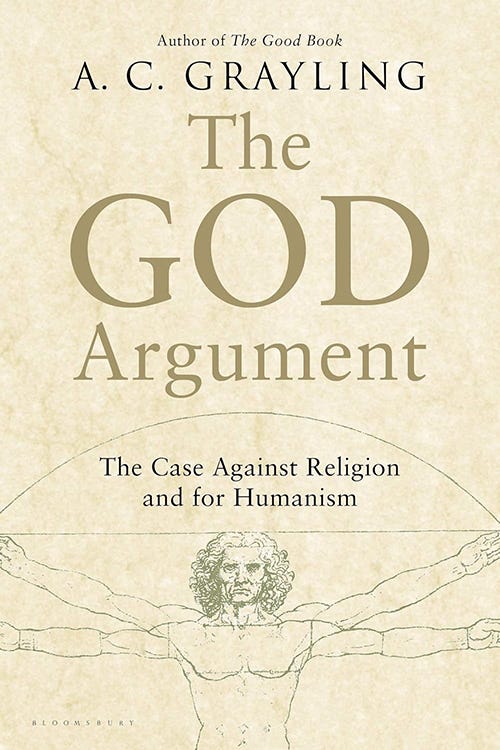
The God Argument by A. C. Grayling is a significant contribution to the debate on religion and secularism. Grayling, a critic of religion, meticulously examines the arguments for the existence of God and the motivations behind religious belief. He then advocates for humanism as a compelling alternative to religion, promoting a worldview grounded in reason, evidence, and a commitment to goodness without infringing on individual beliefs or freedoms.
Grayling presents humanism as an ethical framework based on sympathy and tolerance, aiming to understand human nature and condition. While acknowledging the historical reasons for the emergence of various faiths, he argues that organized religion should no longer hold a privileged status in society. The book asserts that a secular belief system, free from religious dogma, fosters a more compassionate and caring perspective on life.
In No Argument for God, John Wilkinson challenges the prevailing notion that religion is irrational and outdated. While the New Atheists argue that belief in God is a sign of intellectual weakness, Wilkinson asserts that the perceived irrationality of faith is actually a strength. He argues that rationalism imposes artificial constraints on our understanding, focusing only on what can be empirically observed rather than exploring deeper meanings and the “why” behind existence.
Wilkinson contends that while rational investigation is valuable, it often falls short of addressing our deeper yearnings and the search for revelation. He suggests that true understanding and fulfillment come from engaging with the divine in a way that transcends purely logical arguments, leading to a transformative encounter with God that satisfies both the mind and the soul.
As I sit here pondering the state of our society, I can’t help but feel a sense of unease. We live in an age where information is at our fingertips, yet paradoxically, it seems we’re drifting further from a shared understanding of reality. This disconnect has been gnawing at me lately, and I feel compelled to share my thoughts on why I believe scientific facts are not just important but crucial to the health of our democracy.
The Fundamental Truth: Facts Matter
Let’s start with a simple truth: facts matter. They’re not opinions, beliefs, or preferences. They’re the building blocks of our understanding of the world around us. Yet, increasingly, I see people treating scientific facts as if they’re items on a menu, to be selected or discarded based on personal taste. This approach is not just misguided; it’s dangerous.
Understanding vs. Belief: A Critical Distinction
Take, for example, the theory of evolution. It’s not something you “believe in” like you might believe in a political ideology or a religious faith. It’s a scientifically substantiated theory, backed by mountains of empirical evidence. When we start treating such robust scientific theories as mere matters of opinion, we’re treading on thin ice.
This isn’t about belief; it’s about understanding. Belief is subjective and personal. Understanding, on the other hand, is objective and empirical, based on verifiable evidence. When we blur the lines between these two concepts, we open the door to a world where facts become malleable and truth becomes relative.
The Danger of Cherry-Picking Science
I’ve noticed a disturbing trend lately, particularly in the realm of politics. Some individuals in positions of power seem to think it’s acceptable to cherry-pick scientific facts that align with their personal beliefs or agenda, while dismissing those that don’t. This selective acceptance of science is akin to a doctor ignoring crucial medical research because it doesn’t fit their preconceived notions. The consequences can be dire.
Imagine if we applied this approach to other areas of life. Would you want to drive across a bridge designed by an engineer who only accepted the laws of physics that suited their personal beliefs? Would you board a plane piloted by someone who believed gravity was optional? Of course not. Yet when it comes to matters of public policy, some seem all too willing to disregard scientific consensus when it’s inconvenient.
The Erosion of Democratic Discourse
This selective approach to facts doesn’t just affect policy decisions; it erodes the very foundation of our democratic process. Democracy thrives on informed deliberation and decision-making. When we undermine the importance of science and treat every perspective as equally valid, regardless of its factual basis, we degrade our ability to engage in meaningful debate.
In a healthy democracy, we should be able to disagree on how to interpret facts or what policies to implement based on those facts. But the facts themselves shouldn’t be up for debate. When subjective opinions are given the same weight as objective facts, it becomes nearly impossible to build consensus or have constructive discussions. This deterioration of discourse is a severe threat to our democratic process.
The Slippery Slope of Relativism
I fear we’re sliding down a slippery slope towards a kind of intellectual relativism – the idea that everything is just an opinion. This mindset is not only unscientific; it’s fundamentally flawed. In a world where empirical evidence holds no more weight than baseless claims, how can we hope to make progress on crucial issues like healthcare, climate change, or education?
This relativism is a breeding ground for misinformation. In the age of social media, false information can spread like wildfire, and without a shared respect for scientific facts, we lack the tools to effectively combat these falsehoods. We end up in a situation where people can simply choose the “facts” that align with their pre-existing beliefs, creating echo chambers that further divide us.
Science as a Unifying Force
But it doesn’t have to be this way. Science has a remarkable ability to bring people together, transcending cultural, ideological, and religious differences. It provides us with a universal language and a shared understanding of the world around us. When we hold the scientific method in high regard as the ultimate authority, it becomes a powerful tool for achieving consensus and making well-informed decisions.
Science goes beyond individual viewpoints. It serves as a sturdy foundation for public policy and societal progress, enabling us to move forward in a direction that benefits everyone. It’s not perfect – scientific understanding evolves as we gather more data and refine our theories. But that’s the beauty of it. Science is self-correcting, always striving for a more accurate understanding of reality.
Fostering Scientific Literacy
So, what can we do to uphold the integrity of science in our society? First and foremost, we need to foster scientific literacy. This doesn’t mean everyone needs to be an expert in every field, but we should all have a basic understanding of the scientific method and how to evaluate evidence critically.
We need to support science education at all levels, from elementary schools to universities. We should encourage curiosity and critical thinking, teaching people not just what to think, but how to think. This includes understanding the difference between correlation and causation, recognizing cognitive biases, and learning how to evaluate sources of information.
Accountability and Evidence-Based Policy
In our public discourse, we need to hold our leaders accountable when they misrepresent or ignore scientific facts. We should demand evidence-based policies and reject the notion that all opinions are equally valid when it comes to matters of scientific fact.
We also need to work on bridging the gap between the scientific community and the general public. Scientists should strive to communicate their findings in accessible ways, and the media has a responsibility to report on scientific issues accurately and responsibly.
Recognizing the Limits of Science
At the same time, we need to be mindful of the limits of science. While it’s an invaluable tool for understanding the physical world, it doesn’t provide all the answers. There are philosophical, ethical, and personal questions that science alone can’t resolve. Recognizing this can help us use science appropriately without trying to stretch it beyond its purview.
Personal Responsibility and Intellectual Honesty
As individuals, we can start by examining our own biases and being willing to change our minds when presented with new evidence. It’s not always easy – we all have deeply held beliefs – but intellectual honesty requires us to be open to new information, even when it challenges our preconceptions.
We should also strive to create an environment where it’s okay to say “I don’t know” or “I was wrong.” Too often, admitting uncertainty or changing one’s mind is seen as a weakness, when in fact it’s a sign of intellectual growth and maturity.
The Takeaway
In conclusion, the importance of upholding scientific facts in our society cannot be overstated. It’s not just a matter of personal beliefs but a pursuit of objective understanding based on empirical evidence. In a world where science is not held in high regard as a common authority, we risk falling into a state of relativism where everything is subjective and nothing can be proven.
Such a situation not only harms the democratic process but also hinders the overall advancement of society. Science plays a crucial role in informing public policy, guiding decision-making, and bringing people together across different divides.
As we navigate our way through an increasingly complex world, we must uphold the integrity of science, not as a mere belief system, but as a fundamental pillar of knowledge and progress. By doing so, we can build a better future for ourselves and for generations to come – a future grounded in reality, guided by reason, and enriched by our shared pursuit of truth.
Scrolling through online forums like Quora, I often encounter a phenomenon that leaves me scratching my head. Atheist users, in their zeal to promote their beliefs, sometimes fall into the trap of painting all religious people with the broad brush of “gullibility.”
This approach raises several red flags. Firstly, it reeks of dismissiveness, a complete write-off of an entire segment of humanity. It suggests a lack of willingness to engage with religious folks on a deeper level, to understand their perspective, and perhaps even find common ground and help them question their own stand.
Secondly, resorting to derogatory terms for entire demographics is classic bigotry. It’s a simplistic approach favored by populists, not by those seeking genuine understanding.
But today, I want to shift the focus. While the tendency to stereotype religious people as gullible is problematic, it’s important to acknowledge that atheists are not immune to exploitation either. We’re all human, susceptible to the same cognitive biases and emotional manipulation tactics.
Let’s consider a hypothetical scenario. Imagine I crave validation on a platform like Quora. I want my follower count to skyrocket and my every post to be showered with likes. Here’s the recipe for success:
Blame Game: Religion becomes the scapegoat for everything. Every societal ill, every historical misstep, gets pinned on religious dogma, ignoring complex political and historical contexts.
Grand Generalizations: All members of a particular religion are lumped together, overlooking the vast diversity of beliefs and practices within each faith.
Stereotype Soup: I liberally sprinkle my posts with tired clichés about religious folks, reinforcing negative preconceptions.
Condescending Tone: Religious people become “those poor souls” shrouded in delusion, a group to be pitied rather than engaged with.
Monoculture Myth: Faiths are portrayed as monolithic entities, ignoring the rich tapestry of denominations and interpretations within each religion.
Utopian Fantasy: I paint a picture-perfect world where all problems vanish the moment religion exits stage left, conveniently ignoring that ideologies, nationalism, and tribalism can be equally manipulative.
Following this path might garner a temporary spike in online popularity. But ultimately, it creates an echo chamber devoid of intellectual honesty. We end up preaching to the converted, further solidifying existing biases without fostering genuine dialogue.
So, instead, we must acknowledge that religion is a multifaceted phenomenon that encompasses a diverse array of beliefs and practices. To truly understand it, we must seek nuance, recognize its complexity, embrace context, and look beyond religious labels to explore the historical, political, and social factors that influence people’s beliefs.
Engaging with religious individuals on a personal level is crucial for fostering respectful dialogue, allowing us to understand their motivations and perspectives and help them reconsider their positions. It’s also important to challenge our own biases, as regularly examining our assumptions helps us approach conversations with greater openness. By focusing on building bridges rather than walls, we can find common ground and shared values, facilitating a more inclusive and understanding dialogue between atheists and religious individuals.
By adopting these principles, we can move beyond unproductive stereotypes. We can create a space for genuine human connection, regardless of one’s belief system. After all, fostering critical thinking and a healthy dose of skepticism is crucial for everyone, atheist or otherwise.
Religious belief has been a cornerstone of human civilization for millennia; as a result, atheism often finds itself in a challenging position. The question posed to atheists is simple and complex at the same time: Do atheists truly maintain that more than 7 billion people today, and roughly 100 billion people throughout the history of our species, are entirely wrong in their belief in a deity?
This question touches on several important aspects of the debate between theism and atheism, including the nature of belief, the validity of popular opinion, and the importance of evidence in forming worldviews. Let’s delve deeper into these issues and examine the atheist perspective on this complex matter.
The Fallacy of Argumentum ad Populum
One of the first points to address is the implicit appeal to popularity in the question. The fact that billions of people believe in a deity doesn’t necessarily make that belief accurate. This logical fallacy, known as argumentum ad populum or the bandwagon fallacy, suggests that an idea must be accurate simply because many people believe it.
History provides numerous examples of widely held beliefs that were later proven false. The response to the question astutely points out one such example: “For two millennia people believed corn and sweaty shirts created mice.” This refers to the concept of spontaneous generation, an idea proposed by Aristotle and widely accepted until the 19th century. Despite its longevity and popularity, this belief was ultimately disproven through scientific investigation.
This historical example serves as a potent reminder that the number of people believing in something, or the duration of that belief, is not a reliable indicator of its truth. It underscores the importance of skepticism and the need for evidence-based reasoning, which are fundamental principles of the atheist worldview.
The Human Tendency to Seek Explanations
The response also touches on an important aspect of human psychology: our innate desire to find explanations for the world around us. As stated, “We live in a world where everything is the result of something else. It is the logical and easy conclusion to find a God in that sense.”
This observation highlights the appeal of theistic beliefs. The concept of a divine creator offers a seemingly simple explanation for the complexities of the universe and our existence within it. It provides answers to profound questions about the origin of life, the purpose of existence, and the nature of morality.
However, the response goes on to point out a crucial flaw in this reasoning: “Yet this conclusion usually fails in itself because it cannot explain where Gods come from.” This touches on the problem of infinite regress. This philosophical conundrum challenges the idea of a first cause or prime mover. If everything must have a cause, then what caused God? And if God doesn’t need a cause, why does the universe need one?
This line of thinking demonstrates the atheist commitment to logical consistency. While the idea of a deity may offer comfort and apparent explanations, it often raises more questions than it answers when subjected to rigorous logical scrutiny.
The Nuanced Position of Atheism
Perhaps the most important point raised in the response is the clarification of the atheist position: “Atheists do not have any claims; in other words, atheists do not say there is no God. But they reject the notion that there is enough evidence for God’s existence.”
This statement addresses a common misconception about atheism. Many people assume that atheists categorically deny the existence of any deity. In reality, most atheists take a more nuanced position. They don’t claim absolute certainty that no gods exist; rather, they assert that there isn’t sufficient evidence to justify belief in any gods.
This stance aligns with the principle of the burden of proof in logical argumentation. Generally, the burden of proof lies with the person making a positive claim. Atheists argue that theists, who claim that a god or gods exist, bear the responsibility of providing evidence for that claim. In the absence of compelling evidence, atheists withhold belief.
The response acknowledges a critical caveat: “However, most [atheists] are well aware [that] absence of evidence doesn’t mean evidence for absence.” This demonstrates intellectual honesty and an understanding of the limitations of knowledge. Atheists generally recognize that it’s impossible to prove a universal negative – that no gods exist anywhere in the universe. Instead, they maintain a skeptical position, open to evidence but unconvinced by the arguments and evidence presented thus far.
The Importance of Evidence and Skepticism
The final point made in the response draws a parallel between belief in gods and religion in other supernatural entities: “But of course, this applies to unicorns too.” This comparison serves to illustrate the consistent application of skepticism and evidential standards that atheists advocate.
Most people don’t believe in unicorns, not because they can prove they don’t exist, but because there’s no reliable evidence. Atheists apply this same reasoning to claims about deities. They argue that extraordinary claims require extraordinary evidence and that the existence of a supreme being certainly qualifies as an extraordinary claim.
This emphasis on evidence and skepticism is at the heart of the atheist worldview. It’s not about denying the experiences or beliefs of others, but about promoting a method of understanding the world based on observable evidence, logical reasoning, and scientific inquiry.
The Takeaway
The question of whether atheists believe that billions of people throughout history have been wrong about the existence of gods is complex and multifaceted. While it may seem audacious for a minority viewpoint to challenge such a widely held belief, the atheist position is grounded in principles of logical reasoning, evidential standards, and intellectual honesty.
Atheists don’t necessarily claim that all believers are “completely wrong.” Instead, they argue that the evidence presented for the existence of deities is insufficient to justify belief. They recognize the human tendency to seek explanations and find meaning, but they advocate for a more rigorous, evidence-based approach to understanding the world.
In the end, the atheist perspective isn’t about dismissing the beliefs of others, but about promoting critical thinking, skepticism, and a commitment to following the evidence wherever it leads. It’s a worldview that values intellectual integrity over comfort, and that seeks to understand the universe through observation, reason, and science.
As our understanding of the world continues to evolve, it’s crucial that we remain open to new evidence and willing to challenge our assumptions. Whether one is a theist or an atheist, this approach to knowledge and belief can lead to a deeper, more nuanced understanding of our world and our place in it.
Scientists frequently express amazement at the seemingly fine-tuned universe, where the exact values of physical constants and laws appear precisely calibrated to sustain life. This extraordinary precision is vital; even minor variations in these constants might lead to a barren universe devoid of stars, planets, and the chemical processes necessary for life.
The intricate equilibrium of our universe prompts deep inquiries into the genesis and framework of the cosmos, compelling scientists to demystify the enigma of its precise orchestration. The improbability of such ideal conditions emerging by chance evokes wonder and inquisitiveness, propelling the quest for fundamental principles or insights that might illuminate this fine-tuning.
Embark with us on a journey to decipher the puzzle of the fine-tuned universe through both scientific and theological lenses.
The immensity of the cosmos has always fascinated humanity, prompting us to ponder the beginnings and framework of the universe, as well as our place in it. The multiverse hypothesis, emerging from diverse physics and cosmology disciplines, introduces a profound and intriguing concept: our universe is not the only one, but merely a part of a potentially boundless ensemble of universes.
At the core of the multiverse hypothesis lies the enigmatic domain of quantum mechanics. The many-worlds interpretation, a controversial yet fascinating view on quantum events, suggests that all possible outcomes of a quantum occurrence do happen. This implies that every choice, every quantum-level random event, causes the universe to split into separate realities. Each reality holds a distinct version of existence, possibly including every imaginable variation of physical laws and constants. Such a vast collection of alternatives could explain the variety within our universe, hinting at countless different realities beyond our own.
An exciting aspect of multiverse theory stems from inflationary cosmology, which suggests that the early universe experienced a rapid expansion known as inflation. If this inflation occurred unevenly across space, different areas might have stopped inflating at various times. These areas could have developed into isolated “bubble universes,” each with its own physical laws and constants. Inflation, therefore, might have produced a vast, potentially infinite collection of universes, making the observed diversity a matter of statistical probability.
String theory, which aims to reconcile nature’s fundamental forces, introduces another layer to the multiverse concept by proposing that fundamental particles are not point-like but rather tiny, vibrating strings. The way these strings vibrate determines the properties of the particles they represent. String theory allows for many possible configurations, each of which could result in a different set of physical laws and constants, suggesting that each configuration might correspond to a separate universe within the multiverse, offering a theoretical foundation for the existence of multiple physical realities.
The multiverse concept provides a fertile context for the anthropic principle, which posits that our universe is observable because if it were fundamentally different, we wouldn’t exist to observe it. Given a vast multiverse with diverse physical laws and constants, it’s unsurprising that at least one universe would have the right conditions for life as we know it, negating the need for a “designer” to fine-tune the universe for our existence. This offers an alternative explanation for the precise alignment of physical constants that enable life.
Furthermore, the multiverse theory could address the fine-tuned universe problem, which arises from the observation that many physical constants in our universe appear precisely calibrated for the existence of stars, planets, and life. The odds of these constants randomly aligning to support life seem incredibly slim. However, in a multiverse with countless universes and varying constants, the statistical likelihood that at least one universe would have the exact conditions for life makes our universe seem less like a perplexing outlier and more like a natural outcome within an immense cosmic landscape.
Although the multiverse hypothesis extends beyond the scope of directly observable science, its potential to explain the complexity and variety of the universe is clear. It challenges us to reconsider our place in the cosmos, moving from the concept of a single universe to a vast array of possibilities. With technological advancements and a deeper understanding of the cosmos, exploring the multiverse’s mysteries is a fascinating and persistent endeavor.
The God hypothesis proposes the existence of a divine creator or supreme being as the fundamental reason for the universe’s origin, structure, and purpose, encompassing its laws, complexity, and life.
The fine-tuned universe issue, which underscores the apparently unlikely calibration of physical constants necessary for life, leads to diverse interpretations. Unlike scientific methods, the God hypothesis provides an explanation based on faith and the notion of a divine architect.
At the heart of the God hypothesis lies the concept of purposeful design. The complex and life-sustaining characteristics of the universe are seen as the handiwork of a creator who intentionally shaped the cosmos with particular conditions in mind. The unlikely values of physical constants, the laws governing physics, and the initial conditions leading to our universe’s birth are viewed not as coincidental or statistically necessary but as deliberate choices by a designer imbued with intent and significance, indicating a purposeful creation rather than a random event.
Proponents of the God hypothesis often regard it as a straightforward and explanatory model. It provides a singular response to the question of why the universe is conducive to life, avoiding the need for speculative and presently unobservable notions such as the multiverse, which suggests an extensive collection of invisible universes. For these individuals, invoking a divine creator offers a lucid and all-encompassing rationale that aligns with their beliefs and perception of existence.
The God hypothesis extends beyond empirical science into philosophical and theological domains, addressing questions of the universe’s origin, purpose, and meaning through religious and metaphysical lenses. This contrasts with scientific inquiry grounded in evidence and testable theories within the natural world. Advocates of the God hypothesis may suggest that science’s inherent limitations prompt the need for supernatural or metaphysical explanations to account for the universe’s complexity and apparent fine-tuning.
There are epistemological distinctions between the God hypothesis and scientific hypotheses. The God hypothesis exists outside the scope of methodological naturalism, the principle that underpins scientific investigation by seeking natural causes for observed phenomena. Based on faith and metaphysical contemplation, the God hypothesis is separate from scientific hypotheses, which are contingent upon empirical evidence and the possibility of testing.
In summary, the God hypothesis presents a unique viewpoint on the fine-tuned universe issue. Although it does not conform to the principles of scientific investigation, it appeals to those who seek meaning and explanation in the idea of a divine creator. Acknowledging the essential distinctions between this perspective and scientific explanations is vital for appreciating the varied methods humans employ to confront the enigmas of the universe and our existence in it.
Some believe we are presented with only two options: either a deity created the universe and life on Earth through supernatural means, or no deity exists at all, which is a false dichotomy.
A prominent concept that helps us understand the universe’s apparent fine-tuning is the Non-Overlapping Magisteria (NOMA), introduced by Stephen Jay Gould.
This concept posits that science and religion explore separate domains of knowledge, known as “magisteria.” Science investigates the empirical universe, building theories based on observable evidence and repeatable experiments. Religion, conversely, addresses profound ethical, existential, and metaphysical questions, often beyond the physical world. From this standpoint, the multiverse theory, which examines the universe’s structure and mechanics, does not inherently conflict with or disprove the existence of a deity, as they pertain to entirely separate realms.
However, alternative viewpoints question this strict division. Certain theistic beliefs harmonize the concept of the multiverse with the existence of a divine creator by suggesting that God is the originator of the multiverse itself. This implies that God did not just create our particular universe but also the laws and constants that govern the myriad of universes within the multiverse. Thus, the multiverse is seen as an extension of a larger divine scheme rather than a contradiction.
Additionally, the significance of metaphysical and theological interpretations must be recognized. These interpretations provide a unique layer of comprehension that often goes beyond scientific explanations. From this vantage point, the existence of God does not depend solely on deciphering the universe’s physical complexities. Rather, it is an act of faith anchored in profound philosophical and theological structures that search for meaning outside the physical domain. Even if the multiverse offers a scientific rationale for the fine-tuned universe, it does not necessarily invalidate these beliefs based on faith.
It’s also crucial to acknowledge the limitations of scientific explanations. While the multiverse theory may account for the fine-tuning observed in our universe, it could lead to more profound existential inquiries. Questions like why the multiverse exists or why the laws of physics vary across universes may elude scientific explanation and require interpretations that could be theological in nature.
The connection between the multiverse and the divine largely depends on one’s concept of God. Various religions and philosophical doctrines offer widely differing perspectives on the divine. To some, God is deeply integrated into the universe’s fabric, with its intricate design reflecting God’s active involvement. To others, God represents a more abstract, deistic force external to the universe and does not intervene in its dynamics. The multiverse concept could profoundly challenge certain views of God but may not affect other beliefs.
The interaction between the Multiverse and Divine hypotheses provides a complex framework for reflection, transcending the dichotomy of solely scientific or theological explanations for the universe. It uncovers the intricacies involved in harmonizing the expansive theories of the multiverse with the intimate, belief-based notions of a divine creator. The Non-Overlapping Magisteria (NOMA) principle proposes a harmonious existence between science and religion, each addressing distinct aspects of human comprehension. However, conversations often blend these realms, pushing the limits of our knowledge and beliefs.
Certain theological views incorporate the multiverse as an aspect of divine creation, portraying a God not confined by our universe but rather as the designer of a vast multiverse, with each universe serving as evidence of divine limitless imagination, thus broadening the traditional understanding of God to one capable of creating endless possibilities. In contrast, some argue that the precise and purposeful design of the universe suggests a God intricately involved in creation’s details, indicating a universe intentionally formed for life. These differing perspectives underscore the variety within theological discourse, showing the diverse interpretations of the divine across various belief systems.
As science progresses and pushes the limits of our knowledge, it may help us grasp the intricacies of the universe’s fine-tuning. Yet, the profound existential queries about purpose and significance might always remain within the sphere of individual belief and philosophical contemplation. Whether viewed through the prism of science, faith, or a combination thereof, delving into the origins and framework of the universe continues to be a deeply significant pursuit, driving us to search for insights that extend beyond what we can see, into the domains of the theoretical and the spiritual.
Resurrection embodies the concept of returning to life after death, revered, celebrated, and deeply ingrained in humanity’s spiritual and cultural awareness. The resurrection of Jesus Christ, detailed in the New Testament, stands as a significant event that has influenced history and emerged as a potent symbol of the world’s predominant religion.
Join us as we explore what might have occurred in Jerusalem 2000 years ago and consider how such an event would be interpreted today.
Resurrection in the Morgue, AD 1969
In the heart of the 1960s, a decade marked by transformation and upheaval, a family in a quiet town faced their own personal revolution. It began with an innocent mistake: a young girl, full of life and curiosity, accidentally consumed a considerable amount of antiepileptic drugs belonging to her uncle. The medication, potent and unforgiving, swiftly coursed through her veins, ushering her into a dangerous slumber.
Frantic and fraught with fear, her family rushed her to the nearest hospital, their hearts heavy with dread. The medical team sprang into action, a flurry of white coats and urgent voices, but despite their efforts, the girl’s vital signs waned. In a solemn declaration, she was pronounced dead, her body transported to the cold stillness of the hospital’s morgue.
The morgue, where stories are thought to end, became the unexpected setting for this tale’s dramatic turn. As the chief physician conducted his final, sad duty, a routine procedure to confirm death, something extraordinary happened. The sharp pierce to the sole of the girl’s foot, meant to be a silent confirmation of her passing, instead provoked a startling response — a twitch, a gasp, a sign of life.
This miraculous moment, a reaction in the realm of the deceased, ignited a cascade of questions. Was this a case of medical resurrection, a return from the clutches of death? Or had the girl never truly crossed that final threshold? The incident challenged the definitions of life and death, blurring the lines between the two.
Once shrouded in grief, the family found themselves enveloped in a bewildering joy. Their daughter, whom they had mourned, was with them once more, breathing, moving, alive. The hospital, a place of healing, had become a sanctuary of hope, a witness to a phenomenon that defied explanation.
As we reflect on this story, we are compelled to consider the implications of such an event in the context of historical and religious narratives of resurrection. The tale of Jesus Christ, who was said to have risen from the dead, has long been a source of faith and inspiration. Yet, in the light of modern sensibilities and scientific understanding, we are inclined to seek logical explanations over mystical ones.
The resurrection of Jesus Christ in Jerusalem, AD 33
In the bustling city of Jerusalem, amidst the tension of political unrest and religious fervor, a man named Jesus emerged as a beacon of hope and wisdom. His teachings stirred hearts and challenged conventions, drawing crowds wherever he went.
But as whispers of rebellion grew louder, so did the fears of the ruling authorities. Betrayed by one of his own disciples, Jesus was arrested and subjected to a mock trial. Despite the unjust accusations, he bore his suffering with quiet strength, staying true to his message of love and forgiveness.
Carrying a heavy wooden cross, Jesus was led through the dusty streets to Golgotha, where he would face the ultimate sacrifice. Nailed to the cross, he endured unbearable pain, yet his words were merciful: “Father, forgive them, for they know not what they do.”
As darkness descended upon the land, Jesus breathed his last, his body taken down and placed in a tomb. But the story did not end there.
Three days later, his tomb was found empty, and rumors began to spread like wildfire. Grief-stricken Mary Magdalene, a follower of Jesus, encountered a figure she thought to be the gardener, only to realize it was her beloved teacher, risen from the dead.
Jesus brought hope to the hopeless through his resurrection and light to the darkest of nights. His crucifixion became the ultimate symbol of redemption, offering salvation to all who would believe.
In the contemporary era, dominated by scientific inquiry and technological advancement, the ancient resurrection stories are often viewed through skepticism. The modern mind, shaped by empirical evidence and rational thought, tends to question the veracity of such accounts. This skepticism is not just confined to religious narratives but extends to any claim of resurrection or return from death.
When confronted with modern-day occurrences that echo these ancient tales, such as the incident of the girl in the morgue, our first instinct is to turn to medical science for answers. We probe for explanations rooted in physiology and biology, seeking to understand how a seemingly lifeless body could exhibit signs of life. The possibility of a medical misdiagnosis or a misunderstanding of the body’s responses in critical conditions is often considered before any thoughts of a miracle.
This rational approach also influences how we view historical accounts of resurrection. Suppose irrefutable evidence were to emerge that Jesus was seen alive after his crucifixion. In that case, the contemporary mind might speculate that he had been wrongfully pronounced dead. Hypotheses of suspended animation, a state where the body’s functions are slowed to the point of being imperceptible, or the idea that the crucifixion was non-lethal, would be explored as plausible explanations.
Alternatively, in the absence of modern identification checks, it’s conceivable that the crucified individual could have been a body double of Jesus, who willingly sacrificed himself.
Our Biased Minds
The tale of the girl who awoke in the morgue highlights the biased nature of our perception of events based on their recency. Given the fact that declaring someone dead can be challenging, especially without modern technology, the 1969 incident remains vivid: an error occurred, and the head physician acknowledged it.
On the other hand, for an event that is said to have happened two thousand years ago, even in the absence of an identification check and death certificate, we are ready to jump to conclusions and declare Jesus’ death and resurrection as miraculous and factual.
This bias raises a critical question: do we judge historical narratives through a more forgiving lens simply because of the passage of time? Should the burden of proof for miraculous events be higher for contemporary occurrences than for those shrouded in the mists of history?
In a Nutshell: Resurrection of Jesus Christ
In conclusion, the exploration of resurrection narratives, both ancient and contemporary, invites us to navigate the complex interplay between faith, reason, and historical interpretation. Though separated by millennia, the stories of Jesus Christ’s resurrection and the girl in the morgue in 1969 compel us to confront the limits of our understanding and the biases that shape our perceptions.
The incident in the morgue challenges our assumptions about the finality of death and underscores the fallibility of human judgment, even in matters as grave as pronouncing someone deceased. It serves as a sobering reminder of the potential for error in interpreting historical events, particularly those shrouded in religious significance.
On the other hand, the resurrection of Jesus Christ stands as a cornerstone of the Christian faith, offering believers a profound symbol of hope and redemption. Yet, in an age of scientific inquiry, the skepticism inherent in modern thought prompts us to scrutinize historical accounts through a lens of rationality, seeking naturalistic explanations for miraculous events.
As we wrestle with the complexities of resurrection narratives, we must recognize the constraints of our own viewpoints and stay receptive to truths that surpass our comprehension. Whether seen through the eyes of faith or scrutinized through the demands of scientific investigation, the idea of resurrection still fascinates the human mind, providing glimpses of transcendence in a world limited by mortality.