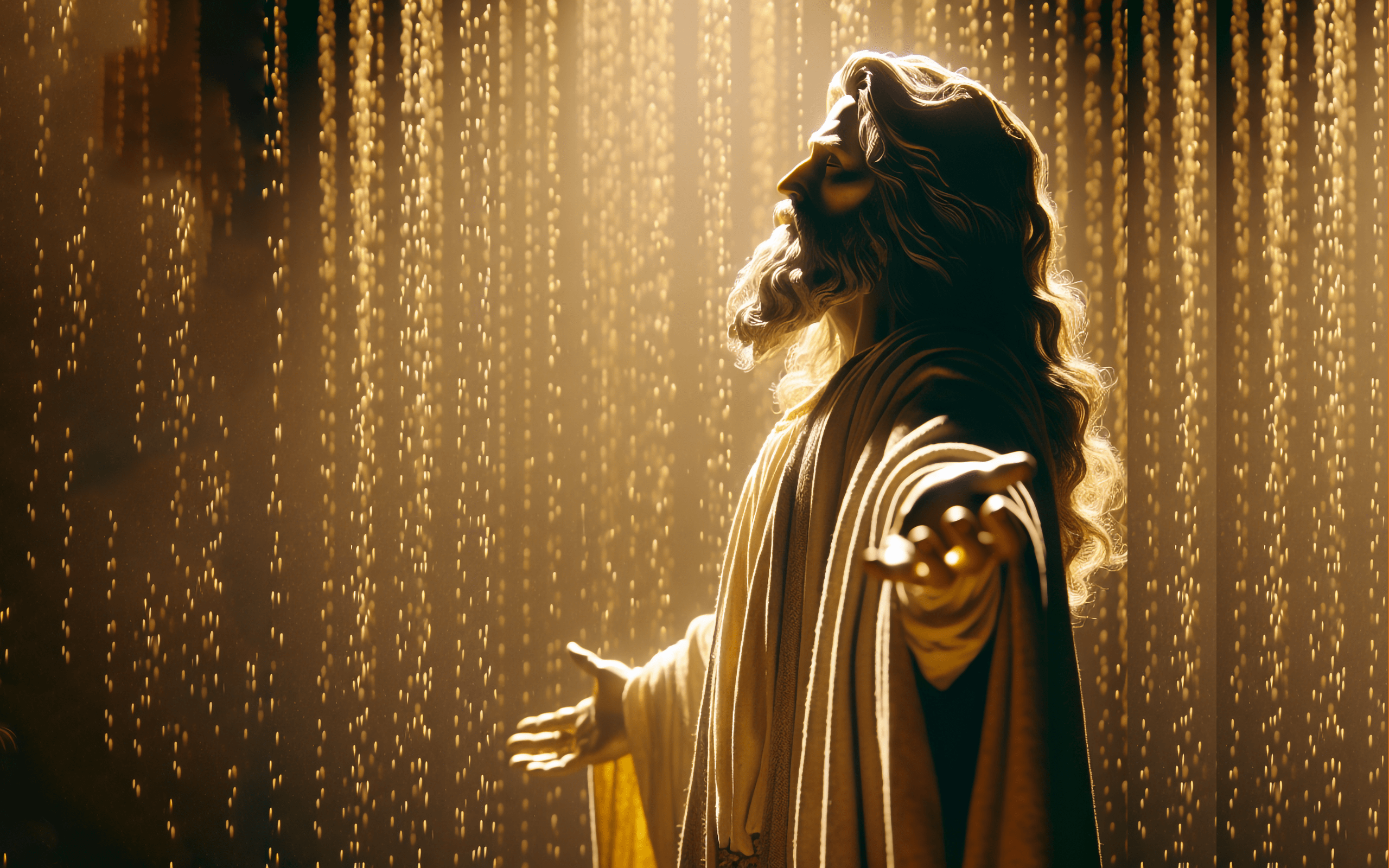
Throughout human history, the question of God’s existence has captivated minds, sparked debates, and shaped civilizations. This intense search has kept countless individuals, from ancient philosophers to modern scientists, awake at night. Yet, despite centuries of contemplation and argumentation, constructing a methodology to definitively prove the existence of God remains an impossible task.
The Nature of Proof
The concept of proof varies widely depending on the context. In scientific contexts, the proof requires repeatable observations and experiments. Scientific proof also involves falsifiable hypotheses to ensure reliable and consistent knowledge.
In mathematics, proof is derived from logical reasoning and axioms. Mathematical proofs are rigorous and precise, often requiring logical iterations to conclusively demonstrate the validity of statements. Unlike scientific proofs, and luckily for mathematicians, mathematical proofs are not subject to change through new observations; once proven, mathematical theorems remain true.
Legal proof, on the other hand, relies on evidence and testimony to establish facts beyond a reasonable doubt. Legal proof involves presenting evidence, such as physical objects, documents, or witness testimonies, to build a case. The goal is to convince a judge or jury of the truth of a claim. While judiciary systems aim to minimize it, the evaluation of legal proof is subjective.
When it comes to proving the existence of God, none of these methods are entirely applicable or sufficient. Scientific proof is limited to the natural world and relies on empirical evidence, which is not easily applicable to metaphysical concepts. Mathematical proof requires logical structures and axioms that are not readily available for theological arguments. Legal proof depends on tangible evidence and testimony and unlike the other two types, it is not objective and universal.
The Limitations of Science
Science has been remarkably successful in explaining natural phenomena and uncovering the mysteries of the universe. Through detailed observation, experimentation, and the development of theories, science has advanced our understanding of everything from the smallest particles to the vastness of space. However, science has inherent limitations when it comes to proving or disproving the existence of God.
One of the main principles of science is methodological naturalism, which means that science operates under the assumption that natural causes explain natural phenomena. While methodological naturalism is powerful for investigating and understanding the world around us, it cannot, by definition, investigate supernatural claims, one of which is God, an entity that is not bound by the laws of nature.
Another limitation is that science relies on collecting data through observation and experimentation in the physical world. God, as typically conceived, exists beyond our physical world, making it impossible to gather direct, empirical evidence of their existence.
Furthermore, although experiments must be repeatable and their hypotheses falsifiable in science, the concept of God often falls outside these criteria.
Lastly, the scope of scientific inquiry is limited to understanding how the natural world works. However, it does not address why the natural world exists in the first place or whether there is a purpose behind its existence, leaving these types of questions to philosophers or theologians.
Philosophical Challenges
Philosophy has long grappled with the question of God’s existence, offering various arguments and counterarguments over the centuries. However, it, too, faces significant hurdles in providing a definitive answer to this impossible question.
One major challenge is the definition of God, which lacks universality as different cultures and religions conceive of divine beings in various ways. Some see God as an all-powerful, all-knowing, and all-good entity, while others have more abstract or varied interpretations. This diversity makes it difficult to prove the existence of any specific deity because the criteria for proof vary widely.
Philosophers have proposed logical arguments for God’s existence, such as Anselm’s ontological argument, suggesting that the very concept of God as the greatest being implies God’s existence, as existence is a necessary attribute of greatness. However, these ontological arguments often rely on disputable premises and word games.
Another significant hurdle is the problem of evil. Should an all-powerful, all-knowing, and all-good God exists, why does suffering occur? Philosophers have struggled with this question for centuries, offering various justifications for God’s tolerance to evil.
The issue of infinite regress also presents a philosophical challenge. The question “If God created the universe, then what created God?” leads to an infinite regress, where each cause must have a prior cause, stretching back infinitely.
The Limits of Human Understanding
The limits of our ability to comprehend the nature of existence and reality become evident when tackling profound questions like the existence of God.
One major limitation comes from cognitive biases. Human thinking is subject to various biases that can influence our perception and reasoning. These biases can lead us to see patterns where none exist, make illogical leaps, or favor information that supports our preconceptions while ignoring evidence to the contrary.
Another limitation is the scope of our perception. Our senses and the instruments we have developed to extend them can only detect a tiny fraction of reality. For example, we cannot see ultraviolet light without special equipment, and we are only beginning to understand phenomena like dark matter and dark energy.
Moreover, the concept of an all-powerful, all-knowing being may be inherently beyond human comprehension. Our brains have evolved to handle the complexities of daily life on Earth, not to grasp infinite or absolute entities.
Faith and Personal Experience
For many people, belief in God is based on faith and personal experience rather than empirical evidence.
One key reason is the subjective nature of personal spiritual experiences. These experiences can be deeply meaningful and transformative for individuals, providing a sense of connection, purpose, or understanding. However, they are inherently subjective and not verifiable by others. What one person experiences as a divine encounter, another may interpret differently or not at all. This subjectivity makes it difficult to use personal experiences as a basis for universal proof of God’s existence.
Another important factor is faith. Religious faith often involves believing without concrete proof. For many, faith is about trust and conviction in the absence of empirical evidence. This means that the quest for definitive, empirical evidence of God can seem somewhat contradictory to the nature of faith itself. Faith is not necessarily about seeking scientific validation but about a personal commitment to a belief system or deity.
The diversity of beliefs around the world further highlights that personal conviction, rather than universal proof, drives belief in God. Different cultures and religions have developed a wide variety of spiritual beliefs and practices, each with their own conceptions of the divine. This diversity suggests that belief in God is often rooted in cultural, historical, and personal contexts, rather than a single, universally accepted proof. The existence of many different religions and spiritual paths indicates that what is compelling or convincing for one group may not be for another, underscoring the role of personal and collective experiences in shaping belief.
The Problem of Unfalsifiability
A key issue in proving God’s existence is the concept of unfalsifiability.
One aspect of this issue is the shifting goalposts. As science explains more natural phenomena, the domain of God often shifts to areas that are not yet explained. This means that as our scientific understanding grows, the idea of God is continually repositioned to remain outside the reach of scientific scrutiny. This perpetual shifting makes the concept of God unfalsifiable, as it continually retreats to the margins of our current knowledge.
Supernatural claims are another factor that contributes to unfalsifiability. By definition, supernatural explanations fall outside the realm of natural investigation. Science is designed to study and explain natural phenomena, so anything deemed supernatural is beyond its scope. Because of this, supernatural claims, including those about God, cannot be conclusively proven or disproven by scientific methods. This inherent limitation ensures that supernatural explanations remain unfalsifiable.
The absence of evidence is also a significant point. While it is true that the absence of evidence is not evidence of absence, the lack of conclusive proof for God’s existence after millennia of searching is noteworthy. Despite extensive philosophical, theological, and scientific inquiry, no definitive evidence has emerged to conclusively prove God’s existence. This persistent absence of evidence highlights the challenge of unfalsifiability, as it suggests that the question of God’s existence may be inherently beyond the reach of empirical investigation.
Logical and Epistemological Considerations
From a logical and epistemological standpoint, proving God’s existence faces several challenges.
One significant challenge is the burden of proof. In logical argumentation, the burden of proof typically lies with the person making a positive claim. If someone asserts that God exists, it is their responsibility to provide evidence to support this claim. On the other hand, proving non-existence is often impossible, as it would require demonstrating that something does not exist anywhere under any circumstances. This asymmetry makes it particularly challenging to address the existence of God through traditional logical methods.
Another influential idea is Russell’s teapot, introduced by philosopher Bertrand Russell. He argued that the burden of proof lies with the person making unfalsifiable claims. Russell used the analogy of a teapot orbiting the sun: while it is impossible to disprove the existence of such a teapot, the lack of evidence for it means that we are not justified in believing in its existence. Similarly, if someone claims that God exists but provides no verifiable evidence, the burden of proof remains on them, as unfalsifiable claims do not warrant acceptance without substantial evidence.
Occam’s Razor also presents a challenge. This principle suggests that simpler explanations are preferable to more complex ones when multiple explanations are available. In the context of the existence of God, Occam’s Razor might favor natural explanations over supernatural ones. For instance, if natural phenomena can be explained through scientific theories without invoking a divine being, the principle of Occam’s Razor would suggest that we should prefer these simpler, natural explanations. This principle encourages skepticism towards more complex, supernatural claims when simpler alternatives suffice.
The Impact of Cultural and Historical Context
Our understanding of God and the quest to prove divine existence are deeply influenced by cultural and historical factors.
One major factor is cultural diversity. Throughout history, different cultures have developed vastly different concepts of divinity. From polytheistic pantheons in ancient Greece and Rome to the monotheistic God of Abrahamic religions, the variety of divine conceptions is immense. This diversity makes it challenging to prove the existence of any one particular god, as each culture’s understanding of divinity is shaped by its unique history, values, and experiences. The multiplicity of beliefs suggests that the concept of God is more fluid and culturally relative than a single, universally accepted entity.
Historical development also plays a significant role in shaping religious ideas. Over time, religious beliefs and practices have evolved, reflecting the changing social, political, and intellectual contexts of different eras. For example, the transition from polytheism to monotheism in many cultures was influenced by broader shifts in societal organization and philosophical thought. These changes indicate that religious ideas are not static truths but are instead dynamic and responsive to the conditions of their time. This historical evolution makes it difficult to argue for the timeless and unchanging existence of a specific deity.
Psychological and sociological factors also contribute to the belief in God. Humans have a natural tendency to seek patterns, meaning, and explanations for the unknown. This inclination can lead to the creation and acceptance of religious beliefs, as they provide a framework for understanding the world and our place in it. Additionally, social structures and communities often reinforce these beliefs, creating a sense of belonging and shared purpose. These psychological and sociological influences suggest that belief in God may arise more from human nature and societal dynamics than from empirical provability.
The Takeaway
The impossibility of proving God’s existence stems from a combination of factors: the limitations of scientific inquiry, the philosophical challenges involved, the bounds of human understanding, the nature of faith and personal experience, the problem of unfalsifiability, logical and epistemological considerations, and the influence of cultural and historical contexts.
Ultimately, the question of God’s existence is about belief rather than proof.

#ExistenceOfGod #FaithVsScience #PhilosophyOfReligion