Tag: Theology

  • The Teachings That Shook Christianity, But Not in a Good Way

    The Teachings That Shook Christianity, But Not in a Good Way

    The Apostle Paul, argueably the father of Christianity as a religion, laid the foundation for much of Christian theology through his letters. However, some of Paul’s teachings were ripe for exploitation over the centuries, leading to interpretations and practices that diverged from his likely original intent.

    Paul’s writing techniques were particularly susceptible to distortion due to their inherent ambiguity, use of metaphors, and context-specific advice that could be generalized or misapplied. His complex theological discussions, especially the tension between law and grace, allowed for selective emphasis, where readers could cherry-pick passages to support their own agendas. The authoritative tone Paul used lent itself to being wielded as a tool for control, while his occasional contradictions and focus on eschatology made it easier for later interpreters to manipulate his teachings for various ends, often distorting his original intent.

    Justification by Faith

    Paul’s teaching that believers are justified by faith alone, without the need for works, was central to his message. However, during the Protestant Reformation and in subsequent periods, this doctrine was sometimes used to argue that moral or ethical behavior was secondary or even unnecessary for salvation, leading to the development of “antinomianism,” the belief that Christians are not bound by moral law, which was far from what Paul originally envisioned.

    Submission to Authorities

    In his letter to the Romans, Paul instructed Christians to “submit to governing authorities” because they are established by God. This teaching has been exploited by various regimes throughout history to justify absolute obedience to tyrannical or unjust rulers. From European monarchies to Nazi Germany, this passage was used to suppress dissent and maintain oppressive power structures.

    The Role of Women

    Paul’s instructions regarding women’s roles in the church, such as women being silent in church and not having authority over men, have been historically exploited to justify the exclusion of women from leadership roles. These teachings were used to reinforce patriarchal structures within Christianity, often ignoring the more egalitarian aspects of Paul’s ministry, where he acknowledged and worked alongside female leaders.

    Slavery

    Paul’s letters contain instructions for slaves to obey their masters, which were later exploited to justify the institution of slavery, particularly in the American South. These passages were used to uphold slavery as a God-ordained practice, despite the broader Christian message of love, equality, and freedom.

    Sexual Ethics

    Paul’s teachings on sexual ethics, including his condemnation of same-sex relations, have been exploited to justify persecution, discrimination, and violence against LGBTQ+ individuals. These passages have been used to marginalize and oppress, rather than to encourage a inclusive and loving community that Paul envisioned.

    Original Sin

    Paul’s teaching on the fall of humanity and the concept of original sin was later developed by theologians like Augustine into a doctrine that became a cornerstone of Western Christian theology. This doctrine has been exploited to justify harsh practices such as infant baptism for the remission of sins and has been used to instill fear and guilt in believers, rather than the grace-filled message Paul intended.

    Eschatology and the End Times

    Paul’s teachings on the return of Christ and the end times have been exploited by various groups throughout history to predict the end of the world. These predictions have sometimes led to extreme behaviors, including withdrawal from society, financial exploitation, and even mass suicides, which are far removed from Paul’s original encouragement for believers to live in hope and readiness.

    Unity and Division

    Paul’s emphasis on unity within the Christian community meant to bring believers together. However, this teaching has sometimes been exploited to suppress dissent and enforce uniformity, leading to the marginalization of differing viewpoints within the church. The misuse of Paul’s call for unity has often killed healthy debate and diversity within the Christian community.

    #ChristianTheology, #ApostlePaul, #ReligiousHistory

  • The Best Arguments for God’s Existence (And Why They Fail)

    The Best Arguments for God’s Existence (And Why They Fail)


    The question of whether God exists is one of the oldest and most debated topics in human history. Over the centuries, philosophers, theologians, and thinkers have proposed countless arguments to support the existence of a divine being. While some find these arguments compelling, others believe they fall short. Today we will get into some of the most famous arguments for God’s existence and discuss why they may not be as convincing as they seem.

    The Cosmological Argument

    One of the oldest and most widely discussed arguments for the existence of God is the cosmological argument. It posits that everything that exists has a cause, and because the universe exists, it, too, must have a cause. This cause, the argument goes, must be something outside the universe and not bound by the same laws — namely, God.

    Why It Fails

    Critics of the cosmological argument often point out that it leads to an infinite regress. If everything must have a cause, what caused God? To counter this, proponents claim that God is a necessary being who doesn’t require a cause. However, this exception seems arbitrary and raises the question of why the universe itself couldn’t be a necessary being without a cause. Additionally, modern physics suggests that the universe could have arisen from quantum fluctuations, challenging the idea that it needs a cause at all.

    The Ontological Argument

    The ontological argument, first proposed by St. Anselm in the 11th century, is more abstract. It starts with the concept of God as the greatest being imaginable. The argument claims that a being that exists both in the mind and in reality is greater than one that exists only in the mind. Therefore, if God is the greatest being imaginable, God must exist in reality.

    Why It Fails

    The ontological argument has been criticized for being a mere play on words. Just because we can conceive of the greatest possible being doesn’t mean that such a being exists in reality. Philosophers like Immanuel Kant argued that existence is not a predicate or a quality that can make something greater. Additionally, the argument can be used to “prove” the existence of any perfect entity, which leads to absurd conclusions.

    The Argument from Design

    Also known as the teleological argument, the argument from design observes the complexity and order in the universe and concludes that it must have been designed by an intelligent being. The complex structure of biological systems, the precise laws of physics, and the fine-tuning of the universe are often cited as evidence of this divine designer.

    Why It Fails

    One major criticism of the argument from design is the presence of flaws and imperfections in the natural world. If an intelligent designer created the universe, why are there so many imperfections and instances of poor design? Additionally, the theory of evolution by natural selection provides a robust explanation for the complexity of life without invoking a designer. The fine-tuning argument also faces challenges from the multiverse theory, which posits that our universe is just one of many, each with different physical constants. In this context, it’s not surprising that at least one universe would have the conditions suitable for life.

    The Moral Argument

    The moral argument suggests that objective moral values and duties exist and that these can only be grounded in a divine being. According to this argument, if God does not exist, objective morals do not exist either. Since we observe moral values and duties, God must exist to provide their foundation.

    Why It Fails

    One issue with the moral argument is the challenge of proving the existence of objective moral values. Moral relativists argue that morals are subjective and culturally dependent. Furthermore, it’s possible to ground morality in secular frameworks, such as human well-being or social contracts, without invoking a divine lawgiver. The existence of moral disagreements and the evolution of moral norms over time also suggest that morality might be more complex and human-centric than the argument allows.

    The Takeaway

    While the arguments for God’s existence have been influential and thought-provoking, they all face significant challenges and criticisms. The cosmological argument struggles with the question of what caused God, while the argument from design is undermined by natural explanations like evolution and the multiverse theory. The ontological argument is often seen as a linguistic trick, and the moral argument fails to conclusively establish objective moral values or their divine origin.

    In the end, whether one finds these arguments compelling often depends on personal beliefs and perspectives. That being said, none of the arguments explain why there has to be only one god and why that god has to be the Abrahamic one.

    Further Reading

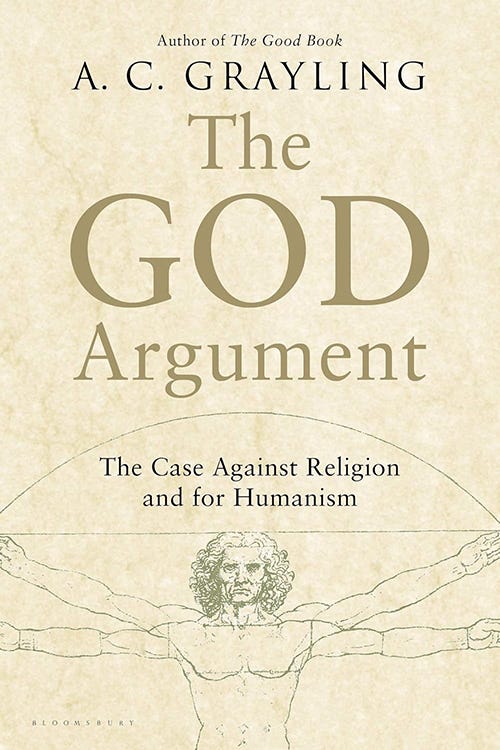
    The God Argument: The Case Against Religion and for Humanism

    The God Argument by A. C. Grayling is a significant contribution to the debate on religion and secularism. Grayling, a critic of religion, meticulously examines the arguments for the existence of God and the motivations behind religious belief. He then advocates for humanism as a compelling alternative to religion, promoting a worldview grounded in reason, evidence, and a commitment to goodness without infringing on individual beliefs or freedoms.

    Grayling presents humanism as an ethical framework based on sympathy and tolerance, aiming to understand human nature and condition. While acknowledging the historical reasons for the emergence of various faiths, he argues that organized religion should no longer hold a privileged status in society. The book asserts that a secular belief system, free from religious dogma, fosters a more compassionate and caring perspective on life.


    No Argument for God: Going Beyond Reason in Conversations About Faith

    In No Argument for God, John Wilkinson challenges the prevailing notion that religion is irrational and outdated. While the New Atheists argue that belief in God is a sign of intellectual weakness, Wilkinson asserts that the perceived irrationality of faith is actually a strength. He argues that rationalism imposes artificial constraints on our understanding, focusing only on what can be empirically observed rather than exploring deeper meanings and the “why” behind existence.

    Wilkinson contends that while rational investigation is valuable, it often falls short of addressing our deeper yearnings and the search for revelation. He suggests that true understanding and fulfillment come from engaging with the divine in a way that transcends purely logical arguments, leading to a transformative encounter with God that satisfies both the mind and the soul.

    #GodExistence, #PhilosophyOfReligion, #CriticalThinking